Very little is known about Luiz José Maria de Oliveira. The few brief passages in newspapers allow us to draw an incomplete portrait of this man, who was a musician, lithographer, merchant and hairdresser.
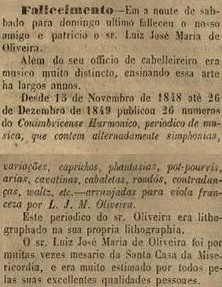
His only known musical work is O Conimbricense Armónico, a periodical published in 26 issues between 1848 and 1849 in the city of Coimbra, lithographed and published by himself. This collection constitutes one of the few examples of compositions for the 6 string guitar in the Portugal during the 19th century.
O Conimbricense Armónico/ Períódico de Muzica/ que contem alternadamente/
Simphonias, Variações, Caprichos, Fantasias,/Pot-pourris, Arias, Cavatinas, Cabaletas,Rondos,
Contradanças e Waltzs Etcª/ Arranjadas/
PARA VIOLA FRANCEZA/por/L.J. M. Oliveira/Coimbra/
Lith de LJM Oliveira/1ª Epoca Nº

This collection is stored – albeit incomplete – in two places: at the Municipal Library of Coimbra (BMC), and at the Library of the University of Las Palmas de Gran Canaria (ULPGC). There are ten issues in the BMC (excluding three duplicates) and eleven in the ULPGC. They coincide except for two issues. The bound volume of the ULPGC came from the collection of the Portuguese bibliophile Annibal Fernandes Tomaz (1849-1911), and was later acquired by the Spanish musicologist Lothar Siemens (1941-2017). This leaves twelve issues out of a possible total of 26, according to handwritten notes on the BMC copies.
The biographical data we have on Luiz Oliveira was obtained in June 2024 by searching parish registers, based on two time frames – the publication of O Conimbricense Armónico in 1848/1849 and an 1870 article in the newspaper O Conimbricense, about the foundation of the Sociedade Dramática Musical, which mentions Oliveira as a ‘performing member’ of its orchestra1. Given the location of his home, the most likely parish to look for his death certificate is São Bartolomeu, and indeed it is there2. According to the register, Luiz Oliveira passed away on September 15th, 1883. His place of birth is recorded as Luso (born September 9th, 1821)3, along with his profession as a hairdresser and the names of his parents and spouse.
The newspaper O Conimbricense of September 18th, 1883 reports on the death of Luiz José Maria Oliveira, mentioning not only his hairdresser profession and civic life, and above all his musical talent, mentioning in detail the publication of the O Conimbricense Armónico.
Luiz Oliveira’s hairdressing salon, located in the main commercial street of the city, was also a place where he sold sheet music, methods and instruments, as well as various magazines. It was also his residence and the place where he gave his music lessons.
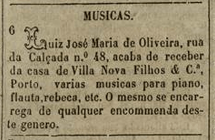
March 19th 1859
Luiz José Maria de Oliveira’s professional activity as a lithographer is also documented through newspaper advertisements for a musical publication called Recreio Musical Conimbricense (1852), with piano pieces, as well as the offer of various lithography services (1856).


Despite this information, nothing is known – as yet – about his apprenticeship and musical career, but we can assume, from the analysis of his compositions and arrangements, that he had a good musical education and access to guitar music by masters such as Aguado and Carulli. The edition of O Conimbricense Armónico displays attention to graphical detail, typos are rare, easily detectable and correctable from the harmonic context. The calligraphy is clean, and the musical examples, with their clear separation of voices, implies knowledge of harmonic rules and composition4.
When I first learnt about this collection a few years ago, I had doubts as to whether Luiz Oliveira was really the author of these works and arrangements. At the time, transnational copyright laws were non-existent or not very far-reaching, and plagiarism and counterfeiting were common practice. In addition, the circulation of the O Conimbricense Armónico would be limited, as a result of a lithographed author’s publication in a city – although important on a national level – far from the great European musical capitals.
To date, I have not been able to find these works in other sources. In those pieces where the author is not named, we can, at least until there is evidence to the contrary, assume that they are originals.The arrangements of opera arias seem to have been adapted from piano reductions, which were widely circulated at the time and which Oliveira would have had access to, and which he would also sell in his salon.
Two works stand out from this collection for their size and virtuosic nature – the Grand Variations and the Variations on a Sentimental Theme. They follow a common pattern in this musical form – introduction (in the case of the second), theme and variations with different textures, changes of tonality, character, metre and time signature.
The Variações sobre um tema Sentimental have just been published (in the Scores section of the website) and the Grandes Variações and the Nova Quadrilhas de Contradanças will soon be available.
I would like to extend my gratitude to my friend Adamo Caetano for the invaluable and vibrant exchange of ideas and insight and to Doc Rossi (@docrossicittern) for revising this translation.
- Along with another figure who would become extremely important in the city’s musical life, the then law student António Simões de Carvalho Barbas (1849-1916). ↩︎
- I would like to thank Jorge Benjamim Gomes Resende and Adamo Caetano for locating these records. ↩︎
- As indicated in the baptismal record dated September 15th, 1821, at the Church of Our Lady of Nativity in Luso.
↩︎ - In contrast, the pieces in Manoel Nunes Aguedo’s Methodo Geral de Viola Franceza, published in Porto in 1856, feature simpler notation, lacking the aforementioned separation of voices. ↩︎
 Rui Namora